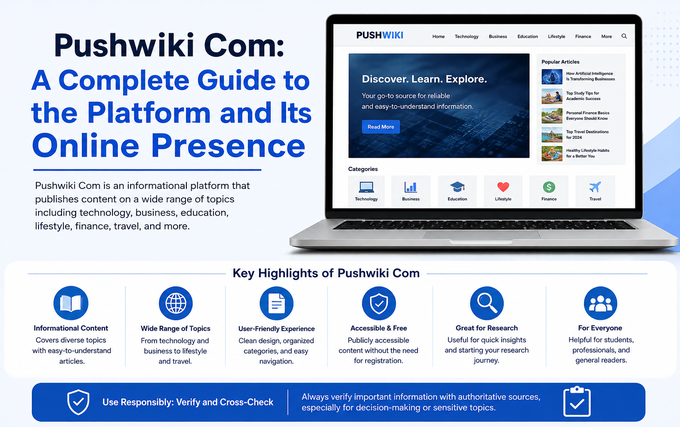

Pushwiki Com has attracted attention among internet users searching for straightforward information, explainers, guides, and answers to everyday questions. The name can initially suggest a traditional wiki or collaborative encyclopedia, but the platform is better understood as an informational publishing website. Its appeal comes from presenting broad subjects in accessible language, allowing readers to explore topics without navigating highly technical academic material. Current online descriptions associate Pushwiki Com with categories such as technology, business, education, finance, lifestyle, travel, and digital topics. However, because several similarly named domains appear online, readers should distinguish the specific website they intend to visit before evaluating its content.
Understanding Pushwiki Com requires more than looking at its name or search-engine visibility. A useful assessment should consider what the platform publishes, how its articles are organized, who may benefit from its content, and how readers should judge the reliability of information presented online. The distinction between an informational blog and a community-edited wiki is particularly important because editorial processes differ substantially between them. Pushwiki Com can be useful as an introductory resource, but readers should still verify important claims through authoritative sources when topics involve law, health, finance, technology security, or other areas where accuracy has practical consequences.
What Is Pushwiki Com and How Should It Be Understood?
Pushwiki Com is best described as a broad informational content platform rather than a conventional, user-edited wiki. Available descriptions indicate that it publishes articles designed to explain subjects in relatively accessible language, with content organized into recognizable categories. Depending on the version or domain encountered, readers may find material involving technology, business, education, digital marketing, lifestyle, travel, finance, and general-interest subjects. This broad editorial approach makes the platform different from a specialist publication that concentrates exclusively on one field. It also means that content quality and depth may vary from article to article, making it sensible to evaluate individual pages rather than assuming every subject receives the same level of expertise.
The term “wiki” can create an inaccurate expectation because established wiki platforms generally emphasize collaborative editing, revision histories, and community participation. Reports examining Pushwiki Com instead describe it as an editorial publishing site, where articles are presented to readers rather than openly edited by a large public community. This distinction matters when assessing authority. A conventional wiki may have numerous contributors reviewing and updating information, while an editorial site depends more heavily on its writers and publishing process. Consequently, Pushwiki Com is most useful when approached as a readable starting point for research rather than automatically treating every article as a definitive reference.
The Main Purpose and Editorial Approach of Pushwiki Com
The apparent purpose of Pushwiki Com is to make online information easier to discover and understand. Instead of requiring readers to work through highly specialized terminology, informational platforms of this type generally use structured articles, descriptive headings, concise explanations, and practical examples. That approach is particularly useful for people conducting initial research, learning unfamiliar terminology, or looking for an overview before moving toward more authoritative sources. Pushwiki Com’s broad subject range reinforces this general-purpose role. Rather than serving one narrowly defined audience, it attempts to attract readers interested in multiple aspects of digital life, education, business, technology, and general knowledge.
From an editorial perspective, accessibility can be a meaningful strength. A technically correct article is not especially useful if an ordinary reader cannot understand it. Clear organization, logical progression, descriptive headings, and practical explanations can reduce the effort required to grasp unfamiliar concepts. Pushwiki Com appears positioned around this kind of reader-friendly experience. Nevertheless, simplicity should never be confused with authority. A concise explanation may provide an excellent introduction while still omitting specialist evidence, technical qualifications, primary documents, or important exceptions. Readers should therefore consider the platform’s content according to the purpose for which they need it.
Pushwiki Com Content Categories and Topics
One notable characteristic of Pushwiki Com is its broad topical coverage. Public descriptions and reviews associate the platform with subjects ranging from technology and business to education, health, law, finance, travel, lifestyle, and digital marketing. Such variety can make the site convenient for readers who prefer one general information resource instead of visiting a separate website for every basic question. It also creates an important limitation: a platform covering many fields cannot necessarily provide the same specialist depth that a dedicated medical journal, technology publication, financial institution, government website, or academic resource can offer.
For SEO purposes, broad topical coverage can also explain why users encounter Pushwiki Com through searches involving very different subjects. Informational websites frequently build collections of articles around questions and search phrases, creating multiple entry points from search engines. For readers, this means an article may answer the immediate question while also introducing related concepts worth researching. The most effective way to use such content is to treat it as part of a research journey. Read the overview, identify useful terminology, examine the references where available, and then consult primary or specialist sources before making decisions based on consequential information.
How Pushwiki Com Differs From Traditional Wiki Platforms
The biggest conceptual difference between Pushwiki Com and traditional wiki platforms is the publishing model. A genuine collaborative wiki normally allows multiple users to create, revise, discuss, and improve entries over time. Pushwiki Com, by contrast, has been described by several current reviews as an editorial content website rather than a community-edited knowledge base. That means visitors should not automatically expect the same revision infrastructure, community oversight, or collaborative fact-checking mechanisms associated with major wiki projects. Understanding this difference prevents readers from assigning the platform a reputation or editorial structure it may not actually possess.
There is nothing inherently negative about being an editorial website. Many respected publications use centralized editorial systems, and a carefully managed publication can produce accurate and useful information without open community editing. The important question is whether readers can understand how the information was produced and whether appropriate evidence supports significant claims. Pushwiki Com should therefore be judged according to conventional website-quality criteria: author transparency, publication dates, sourcing, consistency, editorial clarity, correction practices, and the relevance of supporting evidence. This approach is more reliable than judging credibility simply from the word “wiki” in the domain or brand name.
Pushwiki Com User Experience and Accessibility
A major reason informational websites attract repeat visitors is usability. Readers generally want to reach the relevant information quickly, understand the page structure, and move between related subjects without unnecessary friction. Reviews of Pushwiki Com describe a straightforward, article-focused experience with organized navigation and readable presentation. These characteristics can be valuable for beginners because they reduce the cognitive effort involved in finding information. A clean structure also helps readers scan headings, identify relevant sections, and decide whether an article actually addresses their question before investing time in the entire page.
Accessibility, however, involves more than visual simplicity. Good informational content should use understandable language, meaningful headings, logical paragraphs, descriptive links, and mobile-friendly formatting. It should also avoid making readers depend on unexplained jargon. Pushwiki Com’s broad informational orientation can work well for readers who want introductory explanations, particularly when they are unfamiliar with a subject. At the same time, experienced researchers may require deeper citations, technical documentation, datasets, or primary evidence. Therefore, the platform’s accessibility should be viewed as a practical advantage for discovery and learning rather than evidence that every article provides comprehensive specialist analysis.
Is Pushwiki Com Reliable and Safe to Use?
The question “Is Pushwiki Com reliable?” does not have a useful yes-or-no answer without considering the specific article and domain involved. Current online reporting is inconsistent, partly because multiple websites use similar Pushwiki names and branding. This makes domain verification an important first step. Readers should check the exact web address, examine the site’s About and contact information, look at publication dates, and determine whether an article identifies sources. These simple checks help distinguish the intended Pushwiki website from similarly named properties that may have different owners, subjects, or editorial standards.
Safety and reliability are also separate concepts. A website can be technically accessible while still containing information that requires independent verification. Conversely, a well-written article can be useful without being sufficient evidence for an important decision. When visiting Pushwiki Com, users should avoid assuming that search-engine ranking equals factual authority. For high-stakes subjects, compare information against government resources, recognized professional organizations, academic publications, official company documentation, or other primary sources. This layered approach provides a much stronger reliability assessment than relying on branding, page design, or the confidence of an article’s wording alone.
Why Domain Confusion Matters When Searching Pushwiki Com
Domain confusion is one of the most important issues surrounding searches for Pushwiki Com. Recent web results show multiple domains using variations of the Pushwiki name, including different extensions and hyphenated versions. Some sources explicitly warn that these properties may not represent one unified organization. For users, this creates a straightforward practical problem: an article describing one Pushwiki-branded website may not accurately describe another. Features, authors, categories, ownership information, and editorial policies can differ substantially between domains.
Before trusting or citing information found through a Pushwiki Com search, users should therefore verify the exact domain displayed in their browser. They should also inspect the website’s own About page, contact details, article archive, and privacy information rather than relying entirely on third-party descriptions. This precaution is particularly important when search results contain titles that sound nearly identical. Domain verification is a small step, but it prevents a surprisingly common research mistake: attributing content, reputation, or policies from one website to another unrelated site simply because both use the Pushwiki name.
Using Pushwiki Com Effectively for Online Research
The best way to use Pushwiki Com is as an entry point into a broader research process. Suppose a reader encounters an unfamiliar technology, business term, online service, or educational concept. A well-structured overview can provide useful vocabulary and context, making subsequent research much easier. Readers can then use those newly discovered terms to locate official documentation, specialist publications, government information, or original sources. This approach turns an informational article into a starting map rather than treating it as the final destination. It is especially useful when someone needs a quick orientation before investing time in deeper research.
Readers can improve their experience further by checking several elements before accepting an article’s conclusions. Look for a visible publication or update date, identify the author when available, distinguish factual claims from opinion, and check whether important statements are supported by evidence. It is also worth comparing claims across independent sources when the information could influence money, legal decisions, health choices, cybersecurity, or professional activity. Used in this manner, Pushwiki Com can provide practical background knowledge while the reader maintains appropriate skepticism and research discipline.
Pushwiki Com for Students, Professionals, and General Readers
Pushwiki Com can be particularly useful for readers who need a quick introduction rather than an exhaustive specialist treatment. Students may use broad informational articles to understand terminology before beginning an assignment, while professionals may consult general explainers when they encounter unfamiliar concepts outside their core expertise. General readers can benefit from the same accessibility when exploring technology, business, digital trends, travel, or everyday questions. The platform’s broad subject orientation makes this flexibility possible, although the usefulness of each article depends on its accuracy, currency, depth, and supporting evidence.
Different audiences should nevertheless apply different standards. A casual reader seeking a basic definition may be satisfied with a concise overview, whereas a university student should investigate original references and authoritative literature before citing information academically. Likewise, a professional making a business or technical decision should not rely on a general-interest article when primary documentation is available. This distinction is essential to responsible information use. Pushwiki Com can help people understand a subject quickly, but the appropriate level of verification should increase as the consequences of relying on the information become more significant.
SEO, Search Intent, and the Visibility of Pushwiki Com
From an SEO perspective, Pushwiki Com is interesting because informational platforms can attract visitors by answering highly specific questions. Search users rarely enter broad queries alone; they often type phrases reflecting a particular problem, definition, review, comparison, or “how-to” need. A website that publishes articles addressing these search intents can potentially appear across many long-tail queries. Pushwiki Com’s broad subject coverage provides opportunities for exactly this type of organic discovery. The result is a platform that may be encountered unexpectedly when users search for individual questions rather than intentionally looking for Pushwiki itself.
For readers, however, search visibility should not be mistaken for editorial endorsement. Search engines primarily organize and rank web content according to complex systems, and appearing prominently does not guarantee that an article is the most authoritative source available. This distinction is important for anyone evaluating Pushwiki Com or another informational website. SEO can make useful information easier to discover, but credibility still depends on evidence, transparency, accuracy, freshness, and appropriate expertise. In practical terms, readers should use search rankings to discover information and then use independent verification to determine whether that information deserves confidence.
Strengths and Limitations of Pushwiki Com
Pushwiki Com’s principal strengths are accessibility, broad subject coverage, and its potential usefulness as a quick research resource. Readers who want straightforward explanations can benefit from articles that introduce subjects without requiring advanced prior knowledge. The platform’s general-interest approach can also encourage exploration across unrelated topics, which is useful for people who frequently research different questions. Current descriptions portray the site as freely accessible and organized around informational content rather than a subscription-heavy model. These qualities make it convenient, particularly when the reader’s immediate goal is understanding rather than specialist-level investigation.
Its limitations are equally important. A broad content library cannot automatically provide expert-level depth in every category, and several current reviews note that the platform should not be treated as a replacement for specialized or primary sources. Domain confusion adds another layer of complexity because similarly named websites can create uncertainty about which property a searcher has reached. Readers should therefore combine the platform’s convenience with sensible verification. The strongest approach is neither to dismiss Pushwiki Com outright nor to accept every claim uncritically, but to evaluate each article according to evidence, relevance, authorship, freshness, and the importance of the decision involved.
Frequently Asked Questions About Pushwiki Com
Is Pushwiki Com a traditional wiki? Not in the conventional sense. Current descriptions generally characterize it as an informational publishing platform rather than a large community-edited encyclopedia. Is Pushwiki Com free to access? Several current reviews describe its content as publicly accessible without a subscription or registration requirement. What topics does Pushwiki Com cover? Its reported subject range includes technology, business, education, finance, lifestyle, travel, law, health, and digital topics, although coverage varies. Can Pushwiki Com be used for research? Yes, particularly for initial background research, but important claims should be cross-checked with authoritative sources.
Why are there several Pushwiki websites? Search results currently show multiple domains using similar Pushwiki branding, and available reporting indicates they should not automatically be treated as one organization. Is Pushwiki Com trustworthy? Trust should be evaluated at the individual article and domain level rather than assumed from the name. Can students cite Pushwiki Com? Students should follow their institution’s source requirements and prioritize primary, academic, governmental, or otherwise authoritative references when appropriate. What is the safest way to use Pushwiki Com? Verify the domain, examine the author and date, inspect supporting evidence, and compare important information with independent authoritative sources before relying on it.
The Future Online Role of Pushwiki Com
The long-term value of Pushwiki Com will depend largely on editorial consistency, transparency, content quality, and its ability to distinguish itself from similarly named websites. As online audiences increasingly encounter enormous quantities of automatically produced and search-optimized information, readers are becoming more interested in evidence, identifiable authorship, clear sourcing, and genuine usefulness. An informational platform can build lasting credibility by maintaining accurate articles, updating outdated material, clearly identifying contributors, and providing readers with dependable paths to primary sources. These practices matter more than publishing volume alone.
For Pushwiki Com, the opportunity is therefore straightforward but demanding: become a consistently useful information destination while making its identity and editorial standards easy for readers to understand. If the platform succeeds in combining readable explanations with stronger transparency and reliable sourcing, it can occupy a useful position in the broader online information ecosystem. If readers continue encountering conflicting Pushwiki-branded domains or unclear ownership signals, confusion may remain a barrier. Its future reputation will ultimately be shaped not by the name alone, but by the quality, consistency, and credibility of the information presented under that name.
Conclusion
Pushwiki Com is best approached as an accessible informational publishing platform rather than assuming it is equivalent to a traditional collaborative wiki. Its broad range of subjects can make it useful for discovering explanations, learning unfamiliar concepts, and beginning online research. Current web evidence also shows why readers need to pay attention to the exact domain, since several similarly named websites appear in search results and may not represent the same platform. That distinction is central to understanding the Pushwiki Com online presence accurately.
Ultimately, the smartest way to use Pushwiki Com is with curiosity supported by verification. Read it for context, use it to identify useful concepts and questions, and then consult authoritative sources whenever accuracy carries meaningful consequences. No website should receive automatic credibility simply because it ranks in search results or uses an authoritative-sounding name. Pushwiki Com can be a convenient starting point for online learning, but responsible research means knowing when an introduction is enough—and when deeper evidence is essential.