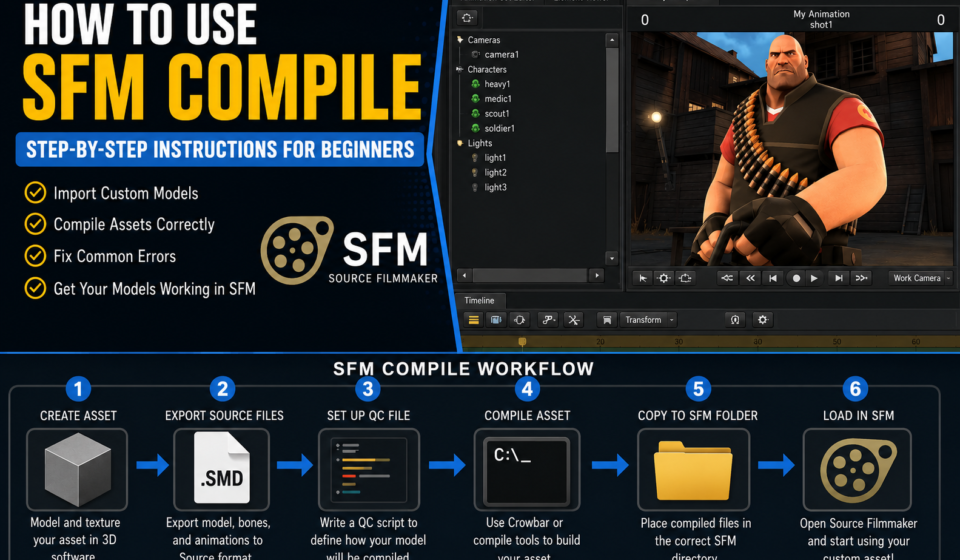

One of the most widely used programs for making animated films, dramatic sequences, and narratives influenced by video games is still Source Filmmaker (SFM). Even though making animations is quite simple, many novices become puzzled when they hear the term SFM compile. To successfully integrate custom models, textures, animations, and maps into Source Filmmaker, one must comprehend the compilation process.Understanding how compilation functions also enables producers to solve frequent problems and generate better work.
What Is SFM Compile and Why Does It Matter?
The process of transforming editable source files into formats that Source Filmmaker can read and utilize is referred to as “sfm compile.” Usually, external software is used to create models, textures, maps, animations, and other assets before they are compiled into files that are compatible with Source Engines. These custom assets cannot be correctly identified or shown by Source Filmmaker without compilation.This procedure guarantees that each file has the structure, metadata, and optimization necessary for the engine to operate smoothly.
Comprehending compilation is crucial for novices as it connects the dots between asset production and animation. Programs like Blender or Maya are frequently used by artists to create models, however those files cannot be easily imported into SFM. Rather, they need to go through certain compilation techniques that produce useful game assets. Early familiarity with this process eliminates import errors, lessens aggravation, and gets artists ready for more complex Source Filmmaker projects that involve unique locations, characters, and visual effects.
Essential Tools Required Before Starting SFM Compile
Gathering the necessary tools is crucial before starting any sfm compilation workflow. Animation and scene development are handled by Source Filmmaker itself, however compilation typically calls for extra tools like Crowbar, Blender Source Tools, Valve’s Source SDK, and texture editing applications. Together, these tools preserve geometry, animations, and material information while transforming unprocessed project files into Source-compatible assets.
Updating all tools enhances compatibility and minimizes unforeseen compilation issues. Because compilation tools rely on precise file paths and directory structures, organizing your project folders is equally important. Many novices encounter destroyed models or missing textures due to improper file storage. Maintaining a tidy workspace from the start improves the efficiency of the compilation process overall and makes managing updates and revisions much simpler in the future.
Understanding Source File Formats in SFM Compile
Understanding the connection between source files and generated output is one of the most crucial ideas in sfm compile. Editable formats like SMD, DMX, QC, TGA, and picture textures produced during production are examples of source files. Model geometry, skeletons, materials, animations, and configuration instructions that specify how the final product operates within Source Filmmaker are all included in these files, which are the raw data needed for compilation.
These source assets are compiled into optimized engine files like MDL, VVD, VTX, and PHY. Within the Source Engine ecosystem, every compiled file has a distinct function. Companion files hold mesh data, collision settings, and rendering instructions, whereas the model file holds general object information. When compiled models fail to load correctly or cause unexpected visual glitches within Source Filmmaker, beginners can find the source of the issue by understanding these file relationships.
Step-by-Step SFM Compile Workflow for Beginners
Using appropriate 3D software to create or prepare the needed object is the first step in a successful sfm compile cycle. Export the project into compatible source formats like SMD or DMX after modeling and texturing are finished. Next, create a QC script that instructs the compiler on how to generate animations, assign materials, assemble the model, and specify output directories. The likelihood of avoidable errors is decreased by carefully examining these parameters prior to compilation.
Once the QC file has been configured, open your favorite build tool and choose the relevant source files. Start the compilation process and keep a close eye out for errors or warnings in the console output. Copy the produced files into the appropriate Source Filmmaker directories after compilation is complete.Check that the asset shows appropriately after opening SFM and loading the model browser. Testing right away enables you to find problems before devoting further effort to scene creation or animation.
Common SFM Compile Errors and How to Fix Them
When compiling sfm, many novices run across mistakes, but the majority of issues have simple fixes. While missing model files are usually the consequence of inadequate compilation or misplaced output directories, missing texture alerts frequently indicate improper material locations.QC syntax mistakes, animation difficulties, and skeleton mismatches are also frequent, particularly when working with custom characters. The precise location of the problem can typically be found by closely examining compiler logs.
Make it a habit to address one issue at a time rather than continuously compiling without research. Verify file names, validate folder structures, and make sure the referenced textures are in the correct places. After writing the QC script, don’t rename files unless all references have been updated. Instead of depending just on trial and error, a methodical troubleshooting technique helps novices comprehend the compilation pipeline and saves a significant amount of time.
Best Practices for Successful SFM Compile Projects
The success rates of SFM compilations are greatly increased by forming persistent routines. Every project should start with well-organized directories that keep source assets, textures, generated files, and backups apart. Because complicated projects might be challenging to manage, use descriptive filenames instead than generic labels. Even with basic backup folders, version control protects against unintentional errors and enables the restoration of earlier functional versions as needed.
Testing assets gradually rather than waiting until a project is finished is another beneficial technique. As soon as each model, animation, or material is complete, assemble them to ensure proper operation. Debugging is significantly simpler with small-scale testing because there are fewer variables.This methodical process gradually increases confidence while lowering the possibility of finding several intricate issues close to the finish of manufacturing.
Optimizing SFM Compile for Better Performance
Effective sfm compilation strategies improve Source Filmmaker’s runtime performance in addition to facilitating successful imports. Rendering times can be increased and viewport responsiveness slowed by highly complex models with an excessive number of polygons, large textures, or superfluous bones. In most situations, optimizing elements prior to compilation keeps editing performance fluid without compromising visual quality.
Optimized compilation assets are a result of texture compression, realistic polygon budgets, streamlined collision meshes, and clean animation data. Whenever possible, steer clear of incorporating extraneous materials or duplicating textures.Similarly, eliminate any concealed geometry that is never visible to the camera. For big film productions with many of unique characters and intricate settings, these optimizations lower file sizes, speed up loading times, and make the editing environment more responsive.
SFM Compile Tips for Faster Learning and Long-Term Success
Because the workflow integrates several software applications, file types, and technical concepts, mastering sfm compile takes patience. Instead of learning commands by heart, beginners should concentrate on comprehending each step. A useful personal reference that speeds up subsequent projects is created by taking notes about compiler parameters, successful settings, and frequent failures. Each finished compilation gains real-world experience, which finally makes the procedure seem natural.
By introducing novices to tried-and-true procedures and troubleshooting tips, participating in active Source Filmmaker communities can also hasten learning. Effective project organization, optimization techniques, and typical pitfalls that might not show up in official documentation might be discovered by watching seasoned producers.Creators can go beyond simple compilation into sophisticated bespoke assets, intricate animation pipelines, and high-caliber cinematic creations by combining regular practice with curiosity.
| Common SFM Compile Issue | Likely Cause | Recommended Solution |
| Missing textures | Incorrect material path | Verify texture folders and QC references |
| Model not appearing | Incorrect output directory | Move compiled files to proper SFM folders |
| Animation errors | Skeleton mismatch | Ensure compatible rigs and exported animations |
| Compile fails immediately | QC syntax mistake | Review script formatting carefully |
| Broken materials | Missing VMT or VTF files | Regenerate or relocate material files |
Frequently Asked Questions About SFM Compile
Many beginners wonder if sfm compilation is required for each Source Filmmaker project. The resources being used determine the response. Additional compilation is typically not necessary if you are dealing only with models that are already part of Source Filmmaker or games that are officially supported.However, because compilation transforms editable files into formats accepted by the Source Engine, anyone importing custom models, animations, maps, or textures has to understand it.
Whether coding expertise is necessary for a good compilation is another frequently asked subject. Thankfully, novices don’t need to be programmers to understand the procedure. QC scripts follow regular patterns that become familiar with experience, even when they contain technical instructions. Even without much software development experience, the majority of users may confidently build custom assets by comprehending file organization, adhering to standard workflows, and closely examining compiler messages.
Conclusion
For anyone who is serious about using Source Filmmaker to create unique material, mastering sfm compile is one of the most important abilities. Even though the workflow might seem complicated at first, it becomes a simple set of procedures when source files, build tools, QC scripts, and asset structure are understood. Efficiency is increased and common mistakes are eliminated with regular practice, meticulous troubleshooting, and well-organized project management. Compilation becomes less of a problem and more of a standard component of creating original characters, professional-caliber animations, and cinematic experiences inside the Source Filmmaker environment as your confidence rises. Gaining proficiency in these principles establishes a solid basis for initiatives that are more ambitious and innovative.